
SSD vs HDD
A hard drive stores data on spinning magnetized platters read by a mechanical arm; an SSD stores it on flash chips with no moving parts. That one difference explains the speed gap, how each survives drops, what each looks like when it fails, and why hard drives still win on price per gigabyte. This page compares the two point by point and ends with a recommendation for each common job.
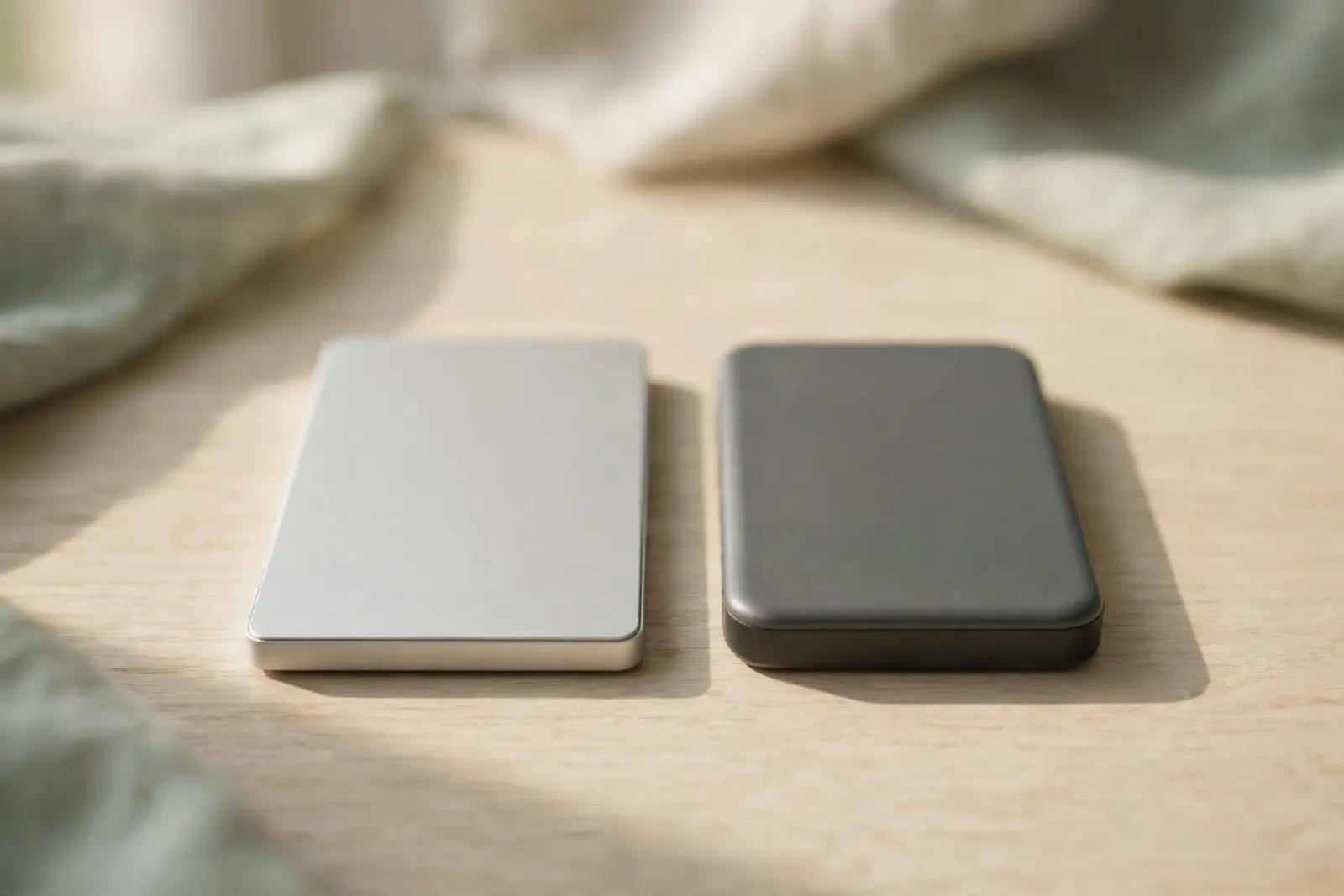
SSD versus HDD comes down to one question: does the drive have moving parts? A hard disk drive (HDD) stores data on spinning, magnetized platters read by a mechanical arm. A solid state drive (SSD) stores the same kind of data on flash memory chips, with nothing that moves. Almost every practical difference follows from that one fact: how fast each drive feels, which one survives a knock, what each looks like when it fails, and how much storage your money buys. This page compares the two point by point and ends with a plain recommendation for the jobs people actually have.[1]
What each drive is
An HDD reads and writes data on one or more magnetically sensitive platters. An actuator arm carries a read/write head for each platter, a motor spins the platters and moves the arms, and an I/O controller with firmware coordinates it all and talks to the rest of the computer. Data lands in tracks and sectors on the platter surface, so every read and write is a physical positioning job: the head has to arrive at the right place before anything moves.[1]
An SSD has no positioning to do. Its NAND flash stores data as an electrical charge (or its absence) in floating-gate transistors arranged in a grid of blocks and pages, and a controller keeps track of where everything lives. The controller also manages wear: each block tolerates only a finite number of rewrites, so the drive spreads writes across the grid and uses TRIM to skip rewriting stale data, which prevents premature wear.[1]
Speed: each is fast at different things
On paper the SSD wins every race, but the difference you actually feel comes from access time rather than raw throughput. SSDs are at their best booting the computer and opening applications, where the drive answers many small, scattered requests. Hard drives remain adequate for large sequential files such as video, where there is little seeking to do. When a computer feels slow, it is usually the small-request case doing the damage, not the big-copy case.[2]
The mechanics explain why. Consumer hard drive platters spin at preset speeds of 4200 to 7200 rpm, and higher speeds correlate with faster read and write rates. Whatever the speed, the drive still waits for the platter to spin into position and the actuator arm to find the right track and sector. That wait is latency, and a hard drive pays it on every small, scattered request.[1]
Two example specs give a sense of scale. Crucial's fastest NVMe SSD, the T705, is specified at up to 14,500 MB/s read and 12,700 MB/s write. Those are vendor maximums for one premium internal drive, not a promise every SSD keeps, but they show where the ceiling sits: far above any spinning drive's transfer rate. Portability costs less speed than you might expect. Crucial quotes read speeds up to 2,100 MB/s and capacities up to 4TB for its external SSDs, figures specific to the X10 Pro Portable SSD.[1]
| Task | SSD | HDD |
|---|---|---|
| Booting and opening applications | Clearly ahead; this is where SSDs deliver the most | The part of an HDD-equipped computer you sit waiting on |
| One large sequential file, like video | Fast | Adequate: little seeking is involved |
| Many small scattered files | No positioning delay | Pays a positioning penalty on each request |
Durability: movement, drops and moving parts
This is where construction becomes something you can feel. An SSD's lack of moving parts makes it lighter and better able to withstand movement and drops. A hard drive's mechanical parts can skip or even fail if the drive is handled roughly or dropped. Crucial calls that a real concern in laptops, and much less of one in a stationary desktop: the drive in your bag needs shock resistance far more than the drive in a tower under your desk.[1]
Noise, power and weight
Run side by side, an SSD is silent and draws less power; a hard drive's mechanics produce wear and noise and draw more power. Neither vendor publishes decibel or watt figures for this comparison, so treat the difference as a direction rather than a number. Even so, anyone who has lived with a spinning drive notices the silence an SSD leaves behind, and the weight difference matters in a laptop or a pocket.[2]
How they fail
The failure profiles differ in shape more than in frequency. A hard drive tends toward predictable, measurable mechanical wear, so an ailing one often gives warning signs first. An SSD faces finite write cycles and can fail suddenly and unrecoverably when its controller dies: in practice, it can work normally one day and be invisible to the system the next.[2]
Do not wait for warning signs from an SSD, because its characteristic failure gives none. If a solid state drive that holds files you care about starts dropping out (missing from the boot list, vanishing from the system), treat whatever time you have as a copy window and get your files onto another drive first.[2]
An SSD has disappeared from the BIOS
Recoverability differs too. When a hard drive fails mechanically, the platters that hold the data usually survive even when the motor, heads, or circuit board do not, which is why professional recovery from a mechanically failed hard drive is often possible. That resilience is one practical argument for spinning drives as an archive medium. A dead SSD controller is a different problem, and what can be done depends on the failure. How SSDs fail covers both paths in detail; how long hard drives last covers what fleet data says about lifespan for either type.[2]
Price: what your money buys
For the same amount of storage, hard drives are frequently less expensive, and the capacity gap runs the same way: Crucial notes hard drives are available with more storage space than SSDs, as much as 2.5 times larger. Western Digital's own comparison puts SSDs at a premium of several times per unit of capacity and expects that gap to persist for years even as both technologies fall in price. In plain terms, the same budget buys several times more storage as an HDD, which is why big, cheap volumes are still spinning.[1][2]
Which one for which job
The standard split, which both drive makers recommend, is to put the operating system and the applications you use every day on an SSD, and leave large, speed-insensitive files (video, photos, document archives) on a hard drive. Boot times and application loading are exactly where the SSD's access-time advantage shows, so that is where the premium does the most work.[1]
For stationary and always-on roles (a desktop's bulk storage, a NAS, a backup archive), the hard drive's weaknesses mostly stop mattering. WD describes the mechanical nature of hard drives as a non-issue for stationary desktops and NAS use, and notes enterprise HDDs are designed for round-the-clock operation with five-year warranties. Combined with the price gap above, that is why NAS boxes and archive drives still ship spinning.[2]
For a drive that travels, the SSD wins: no moving parts to skip when the bag gets set down hard, and a pocket SSD is no longer a speed compromise. The same construction logic settles the narrower question of a USB stick versus a portable hard drive, which is this comparison in pocket form.[1]
USB stick vs external hard drive
Related reading
Not sure which of these describes your situation, or a drive is already misbehaving? Guided help asks a few plain questions and points you to the right place.
Sources
Facts on this page are cited to the publishers’ own documentation.
- [1] Crucial (Micron consumer brand) — SSD vs HDD: Know the Difference | Crucial.com. captured 2026-09-13.
- [2] Western Digital — HDD vs SSD (Compare & Learn). captured 2026-09-13.